
The Psychology of Dining in Private Aviation
The Psychology of Dining in Private Aviation
How environment, perception, and emotional context shape the way passengers experience food onboard.
Dining in private aviation is shaped by more than ingredients or technique. It is influenced by environment, mood, and perception subtle factors that redefine how food is experienced.
Inside a private jet, the setting is controlled, quiet, and highly personal. This creates a unique psychological context where every detail becomes more noticeable, and every choice more intentional.
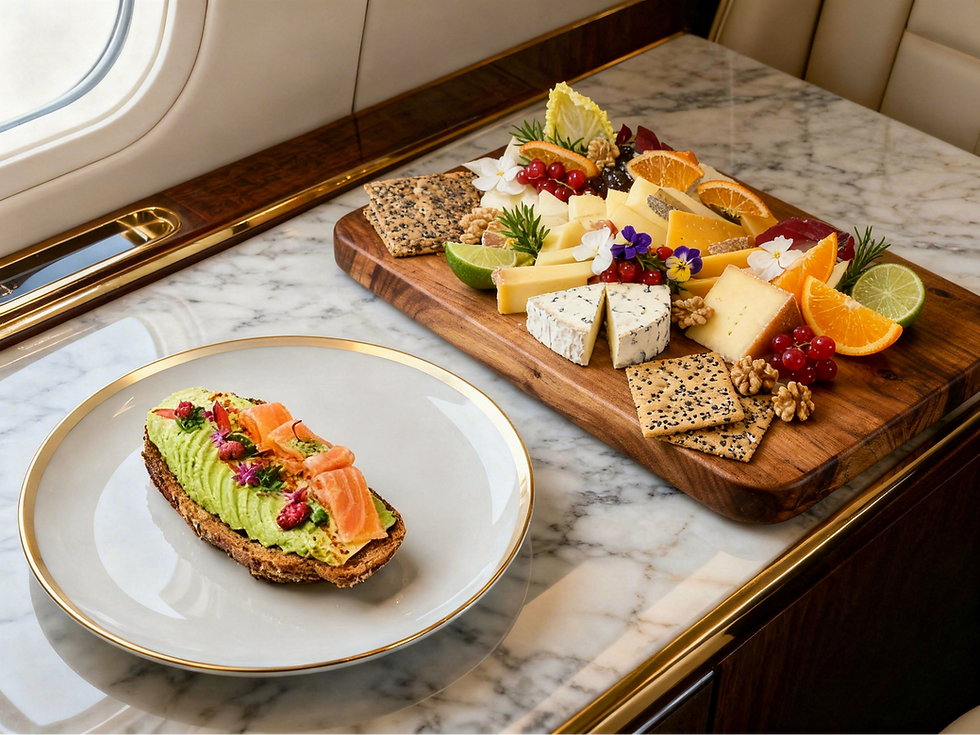
On the other hand, unlike restaurants, where the atmosphere is shared, private aviation offers an intimate and controlled space. Lighting, sound, and spatial design all influence how passengers perceive their meal.
A calm cabin environment can enhance focus on texture and presentation. A relaxed setting may encourage lighter, more mindful dining. Even the view outside the window can subtly affect how a dish is experienced.
In this context, food becomes part of a broader sensory environment.
The role of mental state
Passenger mindset plays a defining role in inflight dining. A traveler preparing for a meeting may prefer light, structured dishes that support clarity such as a superfood salad, fresh berries, or a clean seafood preparation.
Another passenger, transitioning into rest or leisure, may gravitate toward more indulgent options like beef filet with truffle sauce or a smooth chocolate mousse.
The same dish can be perceived differently depending on intention, timing, and emotional state.

Simplicity enhances experience
In a controlled environment, complexity is not always beneficial. Overly elaborate dishes can feel heavy or distracting, while simpler compositions allow each element to be appreciated more clearly. This is why many refined inflight menus focus on balance, clarity, and restraint.
A well-executed salmon tataki, a delicate Niçoise salad, or an elegant pistachio entremet can deliver a more satisfying experience than a composition built on excess. Here, perception is shaped by precision rather than abundance.
Anticipation and comfort
Psychology also influences how meals are structured throughout a flight. Passengers often seek different experiences at different moments, comfort before departure, balance during the journey, and lightness before arrival. Anticipating these shifts is essential in designing menus that feel intuitive rather than imposed.
This is where private jet catering becomes highly specialized.
A deeper understanding of the passenger
At Ukko, menu design goes beyond ingredients and presentation. It considers how passengers think, feel, and behave during their journey.
Operating near Paris Le Bourget Airport, Ukko approaches inflight dining as a combination of culinary expertise and human understanding. Each menu is crafted not only to taste exceptional, but to align with the psychological rhythm of the flight.
In private aviation, food is not experienced in isolation. It is shaped by silence, movement, anticipation, and personal space. It responds to mood, intention, and environment.
Understanding this transforms catering into something more than a service. It becomes a carefully designed experience, where every detail contributes to how the passenger feels.
And at this level, the most successful meals are not simply remembered for their taste, but for how naturally they fit into the journey.
For inquiries or collaborations, contact us
📞 +33 (0) 785 72 01 43


Comments